
How to Rank in AI Search Results with GEO and AEO in 2026
June 3, 2026
Custom Website vs Templates: The Ultimate Guide for Businesses in 2026
June 12, 2026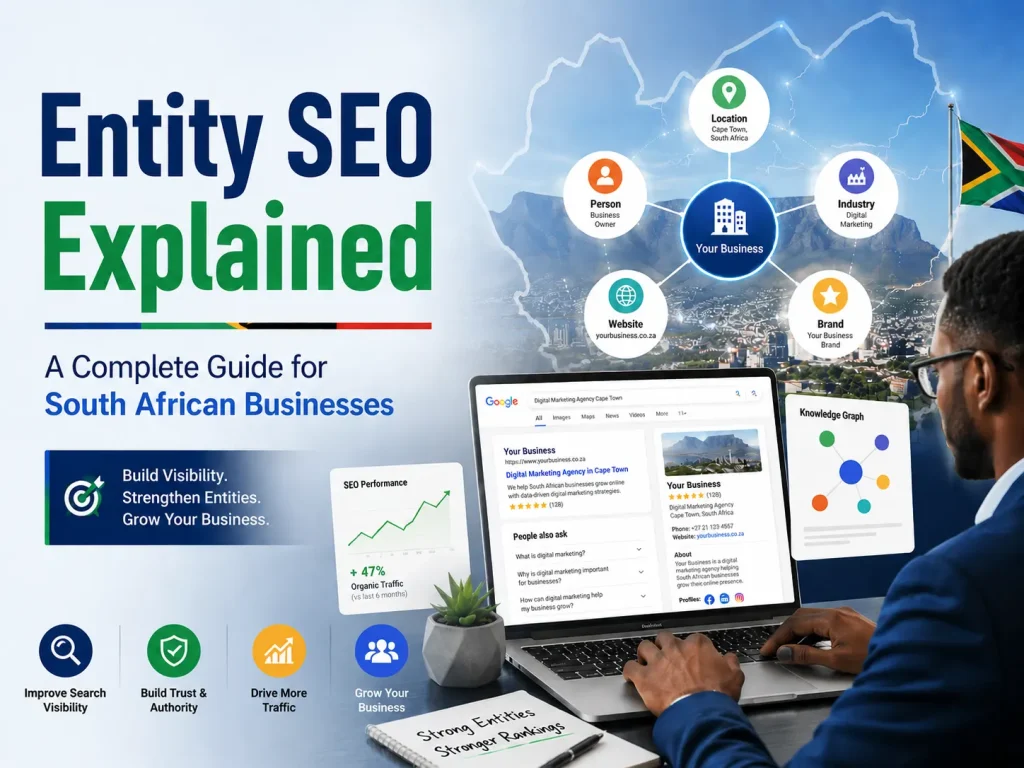
Entity SEO Explained: A Complete Guide for South African Businesses
What Is Entity SEO?
Entity SEO is the practice of making your business clearly identifiable to Google and AI systems as a real-world entity: a thing with a name, attributes, relationships, and a defined place in the world. Google does not just match text on a page. It builds a model of what your business is, what it does, who it serves, and whether it can be trusted.
An entity can be a person, organisation, place, product, concept, or event. When Google confidently understands your business as an entity, it surfaces you for relevant searches, AI Overviews, and voice results without you needing to target every keyword individually.
A keyword is a string of text. An entity is a real thing that exists in the world, understood by Google through its name, context, associations, and credibility signals across the web.
Entity SEO vs Keyword SEO
Traditional keyword SEO focuses on matching exact phrases users type into Google. Entity SEO focuses on becoming the recognised authority on a topic so Google surfaces you across all related queries, including ones you never explicitly targeted.
Keyword SEO asks: what words do people search? Entity SEO asks: does Google understand what my business genuinely is and does? Both matter, but entity SEO is what drives long-term ranking stability in 2026.
Why Entity SEO Matters for South African Businesses in 2026
South African businesses face a specific challenge. Google's local results are competitive, international brands dominate generic terms, and AI tools now answer questions directly without sending traffic to a website unless that site is treated as a credible entity source.
Three Google policies now directly reward entity-optimised content:
Google's Helpful Content Policy rewards content written by real experts for real people. Thin keyword-targeted pages get demoted algorithmically.
Google's Spam Policies penalise AI-generated bulk content, link schemes, and cloaking. Entities with strong real-world signals are far less vulnerable.
E-E-A-T is the quality framework Google's raters use to score every page. No entity signals means no E-E-A-T signals.
E-E-A-T: What It Means and How to Build It
E-E-A-T stands for Experience, Expertise, Authoritativeness, and Trustworthiness. It is Google's internal quality benchmark, applied by human raters and reflected in algorithmic signals.
Experience
Show real work. Case studies, before-and-after results, photos, client outcomes. Only someone who has actually done the work can produce this content.
Expertise
Go deeper than surface-level explanations. Cite South African data, regulations, and industry standards. Author bios with real credentials matter.
Authoritativeness
Get referenced externally. Backlinks from South African publications, industry bodies, and reputable directories build off-site authority signals.
Trustworthiness
HTTPS, privacy policy, real contact details, Google reviews, and Hello Peter presence. Trustworthiness is the most heavily weighted E-E-A-T signal in 2026.
Topical Authority: Cover Your Subject Completely
Google rewards websites that cover a topic so thoroughly that no user needs to go elsewhere. This is topical authority. Instead of one page on "web design Cape Town," a topically authoritative site covers web design, UX principles, responsive layouts, page speed, local SEO, ecommerce, website maintenance, and every question a South African business owner would have along that journey.
How to Build Topical Authority Step by Step
Step 1: Map your core topic and every subtopic, question, and concern your customers have around it.
Step 2: Create a pillar page that covers the main topic broadly. Build supporting blog posts for each subtopic.
Step 3: Link pillar pages and supporting posts to each other using descriptive anchor text.
Step 4: Add local intent throughout. Mention cities, provinces, Rand pricing, and South African examples.
Step 5: Update content every six months with new data, case studies, or industry developments.
Setting Up Your Entity in Google's Knowledge Graph
The Knowledge Graph is Google's database of entities. Your business earns a place in it by providing consistent, verifiable signals across the web.
For South African businesses these are the core requirements:
A fully completed and verified Google Business Profile with accurate categories, hours, photos, and regular posts.
NAP consistency (Name, Address, Phone) across your website, GBP, South African business directories, social profiles, and industry listings.
An About page that clearly states who you are, what you do, where you operate, and who you serve.
Organise schema markup on your homepage so Google reads your entity data in a structured, machine-readable format.
AI-First SEO: Getting Found on ChatGPT, Gemini, and Perplexity
In 2026, a growing portion of search happens inside AI tools. Users ask ChatGPT "what are the best web design companies in Johannesburg?" or ask Gemini for a digital marketing strategy. These tools pull answers from structured, entity-rich, authoritative content. If your website is not that source, a competitor's will be.
Answer Engine Optimisation (AEO)
AEO is the practice of formatting your content so AI systems can extract and cite it as a direct answer. The key tactics are writing clear question-and-answer content, using declarative statements, structuring FAQ sections, and building the entity credibility that AI tools use to select sources.
Generative Engine Optimisation (GEO)
GEO is your full-site strategy for ensuring that when generative AI tools research a topic your business covers, they consistently reference you. This requires topical authority, strong entity signals, clean structured data, and citations from credible South African sources.
Practical Steps for AI Visibility in South Africa
Step 1: Write in clear, declarative language. State facts directly. Avoid filler and vague phrasing.
Step 2: Structure FAQ sections across every major page using FAQPage Schema.
Step 3: Earn citations from authoritative South African publications, industry bodies, and local directories.
Step 4: Keep your Google Business Profile active with fresh posts and updated information.
Step 5: Mention your entity name, location, and service area consistently across all content.
Schema Markup Checklist for South African Businesses
Structured data is the machine-readable layer of entity SEO. These Schema types are the minimum requirement for a South African business website:
- LocalBusiness
- Organization
- FAQPage
- Article / BlogPosting
- BreadcrumbList
- Website with Sitelinks Search Box
- Review / AggregateRating
- Service
Ready to Build Your Entity SEO Strategy?
Most South African businesses are still chasing keywords. The ones pulling ahead in 2026 are building entity authority, earning AI visibility, and creating content that Google genuinely trusts.
At Best Web Design, we build websites and SEO strategies grounded in how Google actually works today, not how it worked five years ago. Whether you need a new website with proper Schema markup built in, a content strategy targeting topical authority, or a full entity SEO audit, we are ready to help.
Get a free SEO consultation with Best Web Design today. Tell us about your business, your current rankings, and your goals. We will map out a clear, practical plan to grow your visibility on Google and across AI platforms.