Entity SEO Explained: A Complete Guide for South African Businesses
June 8, 2026
The Future of Search: SEO, GEO and AI Assistants in 2026
June 16, 2026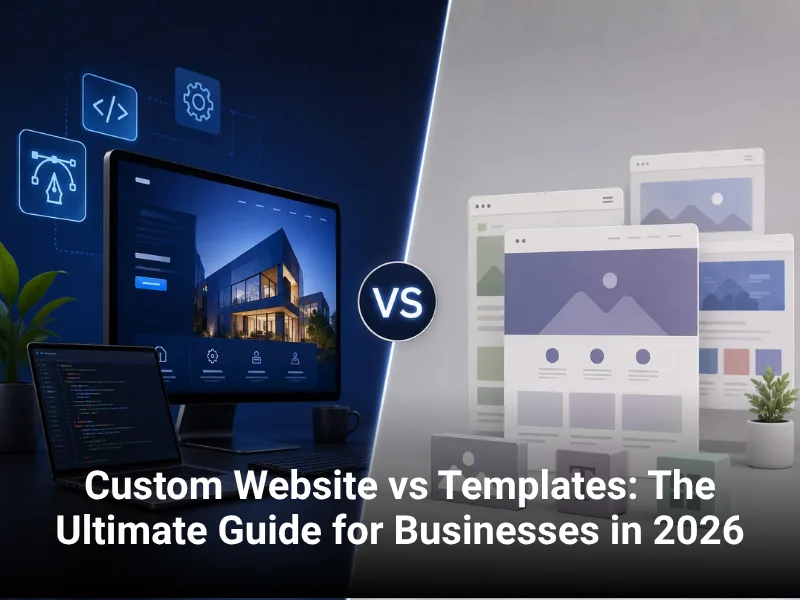
Custom Website vs Templates: The Ultimate Guide for Businesses in 2026
What Is a Custom Website?
A custom website is built from the ground up, designed and coded specifically for your business. Every layout, color, feature, and function is created to match your goals, your audience, and your brand identity.
There are no preset themes, no shared code libraries with thousands of other sites, and no "close enough" compromises. At Best Web Design, we build custom websites that reflect exactly who you are and what you offer.
What Is a Template Website?
A template website uses a pre-built design framework, think WordPress themes, Wix templates, or Squarespace layouts. You fill in your content, pick your colors, and launch.
Templates are fast and affordable. But they come with trade-offs that can cost you traffic, conversions, and credibility down the road.
Custom Website vs Template: The Core Differences
1. Design and Brand Identity
A template gives you a starting point. A custom website gives you an identity.
When your competitor uses the same Wix template with a different logo, customers notice, even if they can't explain why. Custom websites are built around your brand voice, your customer psychology, and your unique value proposition.
Search engines also reward unique, original page structures. Google's Helpful Content guidelines push sites that are clearly made for real users, not just assembled from recycled layouts.
2. SEO Performance
This is where custom websites pull far ahead.
Template websites often ship with bloated code, render-blocking scripts, and shared CSS that slows page load times. Google's Core Web Vitals, specifically Largest Contentful Paint (LCP), Cumulative Layout Shift (CLS), and Interaction to Next Paint (INP), are direct ranking factors.
Custom websites let developers optimize every line of code. That means faster load times, cleaner semantic HTML, proper schema markup, and structured data that helps AI-powered search features like Google AI Overviews, Perplexity, and ChatGPT understand your content.
In 2026, AEO (Answer Engine Optimization) is just as important as traditional SEO. A custom website makes it far easier to implement FAQ schema, how-to schema, and entity-based content that LLMs and AI search systems pull from.
3. E-E-A-T and Topical Authority
Google's E-E-A-T framework (Experience, Expertise, Authoritativeness, Trustworthiness) rewards websites that clearly demonstrate real knowledge and credibility. Template websites often use generic author bios, copy-paste about pages, and no clear content hierarchy.
A custom website lets you build:
- Dedicated author pages with credentials
- Service pages structured around topical clusters
- Trust signals like case studies, testimonials, and certifications built directly into the design
- Internal linking structures that build topical authority across your entire site
4. Flexibility and Scalability
Templates are rigid. You work within the theme's rules. Want to add a custom booking system? A product configurator? An interactive pricing calculator? Most templates can't handle it without third-party plugins that slow your site and create security risks.
Custom websites grow with your business. New features, new pages, new integrations are all built on a foundation that was designed to expand.
5. Security
Template platforms are high-value targets for hackers. Thousands of sites share the same code, so one discovered vulnerability puts everyone at risk. Plugin conflicts, outdated themes, and shared infrastructure are constant headaches.
Custom websites are built with only the code you actually need. Smaller attack surface, easier maintenance, and full control over updates.
When Should You Choose a Template?
Templates make sense in specific situations:
- You are a brand-new business testing an idea with zero budget
- You need a simple one-page landing page for a single campaign
- You have a very short launch timeline, and SEO is not yet a priority
For most established businesses and growth-focused startups, templates become a ceiling rather than a launchpad.
When Should You Choose a Custom Website?
Choose a custom website when:
- You want to rank on Google and build long-term organic traffic
- Your brand needs to stand out in a competitive market
- You need specific features, integrations, or user flows
- You want your site to support AI search visibility (AI Overviews, ChatGPT, Gemini)
- You are serious about conversion rate optimization
Best Web Design has helped businesses across industries move from template limitations to custom-built performance, and the results speak clearly in both rankings and revenue.
SEO and AI Search in 2026: Why Custom Websites Win
Search has changed fast. Google's AI Overviews now answer questions directly in search results. ChatGPT, Gemini, and Perplexity pull answers from websites they trust.
To appear in these AI-generated answers, your website needs:
Structured content that clearly answers specific questions. Custom websites make it easy to build FAQ sections, comparison tables, and how-to content with proper schema markup.
Clean entity coverage so search engines and LLMs can understand who you are, what you do, and who you serve. A custom website lets you build entity relationships intentionally throughout your content and code.
Fast, stable pages that pass Core Web Vitals. AI search systems, like traditional search systems, favor pages that load quickly and behave predictably on all devices.
Authoritative brand signals built into the site architecture. Author pages, about pages, service pages, and case studies all contribute to how AI systems evaluate your trustworthiness.
GEO (Generative Engine Optimization) is the newest layer of this. It means writing content in a way that AI systems can easily extract, summarize, and cite. Custom websites let you format this content precisely, where templates often can't.
How Long Does a Custom Website Take to Build?
A straightforward custom website typically takes 4 to 8 weeks from discovery to launch. More complex builds with custom features, large content libraries, or complex integrations can take 3 to 6 months.
The timeline is worth it. You launch with a site that is built to rank, built to convert, and built to last.
Ready to Build a Website That Actually Ranks?
If you are serious about growing your business online in 2026, a custom website is not optional. It is the foundation everything else is built on.
Best Web Design builds custom websites that are fast, SEO-ready, and designed to convert visitors into customers. Whether you are starting fresh or replacing a template that has stopped delivering results, we can help.
Get in touch with Best Web Design today and let's build something that works.