
How to Get More Google Reviews for Your Johannesburg Business in 2026
May 28, 2026
Entity SEO Explained: A Complete Guide for South African Businesses
June 8, 2026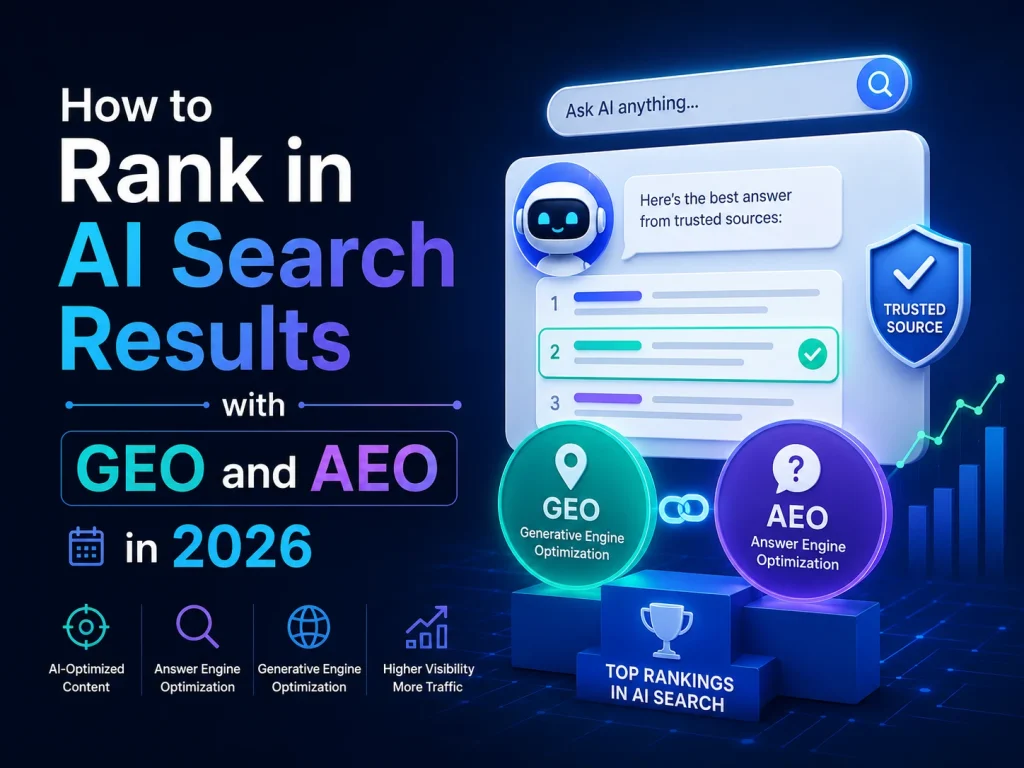

How to Rank in AI Search Results with GEO and AEO in 2026
What Are AI Search Results and Why Do They Matter in 2026?
AI search results are answers generated by large language models (LLMs) like Google Gemini, ChatGPT, and Perplexity. Instead of a list of ten blue links, users get a direct answer — sometimes with citations, sometimes without.
In 2026, this is not a future trend. It is the present reality:
- Google AI Overviews appear on over 40% of informational queries
- ChatGPT processes over 100 million queries per day
- Perplexity has surpassed 10 million daily active users
- Gemini is deeply embedded in Google Search on mobile
If your blog ranks on page one of Google but does not appear in AI search results, you are already losing traffic to sites that have adapted.
This is where GEO and AEO come in.
What Is GEO (Generative Engine Optimization)?
GEO stands for Generative Engine Optimization. It is the process of structuring and writing your content so that AI systems like ChatGPT, Gemini, and Perplexity choose to cite or reference your page when generating answers.
Traditional SEO targets Google's ranking algorithm. GEO targets the language models that pull content to generate responses.
Core GEO Principles
- Cite-worthy content structure AI models prefer content that is factual, structured, and easy to extract. Use clear H2 and H3 headings. Write one idea per paragraph. Avoid walls of text.
- Entity-rich writing LLMs understand topics through named entities—brands, people, places, tools, dates, and statistics. Include specific, verifiable facts. Mention real tools, real data, and real examples.
- Original research and data AI systems favor pages with original data they cannot find elsewhere. Surveys, case studies, original statistics, and unique insights all increase your GEO visibility.
- Source authority signals Get cited by other authoritative sites. When AI trains on and retrieves content, pages with strong backlink profiles and brand mentions are weighted higher.
5. Structured data markup Use Schema.org markup—Article, FAQPage, HowTo — to help AI systems understand what your content contains and how to use it.
What Is AEO (Answer Engine Optimization)?
AEO stands for Answer Engine Optimization. It focuses on making your content the direct answer to a specific question — whether that question is typed into Google, spoken to a voice assistant, or sent to an AI chatbot.
AEO is why FAQ sections, featured snippets, and voice search optimization matter more than ever in 2026.
Core AEO Principles
- Question-first content Write headings as questions. Start answers immediately below the heading. Keep the first answer sentence under 40 words — concise enough to be pulled as a snippet.
- Voice search optimization Voice queries are conversational. "How do I rank in AI search results" is more common than "AI search results ranking." Write the way people talk.
- Featured snippet targeting Google still shows featured snippets alongside AI Overviews. Use definition boxes, numbered lists, and short summary paragraphs to win these placements.
- FAQ schema Add FAQPage schema to your blog posts. This directly feeds both Google's rich results and AI answer systems.
- Conversational keyword clusters Target full questions, not just head keywords. Tools like AlsoAsked, AnswerThePublic, and Google's People Also Ask section reveal the exact questions your audience types.
GEO vs AEO: What's the Difference?
|
GEO |
AEO |
|
|
Goal |
Get cited in AI-generated content |
Become the direct answer to a question |
|
Targets |
ChatGPT, Gemini, Perplexity, Claude |
Google snippets, voice search, AI Overviews |
|
Key tactic |
Structured, entity-rich, cite-worthy content |
Question-based headings, FAQ schema |
|
Measures |
Brand mentions in AI outputs |
Featured snippets, Position 0 |
In practice, good GEO and AEO strategies overlap heavily. Content that follows both produces the best AI search result visibility.
E-E-A-T: The Foundation of AI Search Visibility
Google's E-E-A-T framework — Experience, Expertise, Authoritativeness, Trustworthiness — is not just a ranking factor for traditional search. It is now a signal that AI systems use to decide whose content to trust and cite.
How to Build E-E-A-T Into Your Blog
Experience: Show firsthand knowledge. Include real examples, screenshots, results, and case studies from your own work. "We tested this across 30 client sites and found…" signals real experience.
Expertise: Write with depth. Cover topics thoroughly. Link to credible external sources. Avoid thin, generic content that says nothing new.
Authoritativeness: Build your brand's authority through backlinks, press mentions, and consistent publishing on your niche topics. At Best Web Design, topical authority is built by covering one subject cluster completely before moving to the next.
Trustworthiness: Use HTTPS. Show an About page with real team bios. Display contact information. Avoid misleading headlines, clickbait, and content that contradicts itself.
AI systems — especially Google's Gemini — cross-reference author and brand signals before surfacing content in AI Overviews. E-E-A-T is not optional in 2026.
Topical Authority: How to Own Your Subject in AI Search
Topical authority means covering a subject so completely that search engines and AI systems recognize your site as the go-to resource for that topic.
It is not about publishing one great post. It is about building a content ecosystem.
How to Build Topical Authority
Step 1: Map your topic cluster Pick your core topic (for example: AI search results). Then identify 8 to 15 supporting topics — subtopics, related questions, comparison posts, how-to guides, case studies.
Step 2: Interlink everything Every post in your cluster links to the pillar page. The pillar page links back to all supporting posts. This signals to Google and to AI systems that your site covers this topic in depth.
Step 3: Cover entities, not just keywords AI search engines think in entities — concepts, people, tools, processes. When writing about AI search results, mention related entities: Google AI Overviews, large language models, structured data, schema markup, Perplexity, knowledge graphs. This makes your content more retrievable by LLMs.
Step 4: Update content regularly Stale content loses topical authority. Add new statistics, update examples, refresh outdated advice. A post updated in 2026 outranks an identical post from 2023.
How to Optimize for Google AI Overviews Specifically
Google AI Overviews (formerly Search Generative Experience) pulls content directly from indexed pages. Here is what it prioritizes:
Clear, structured answers: AI Overviews favor pages that answer the query in the first 100 words, then go deeper. Lead with the answer.
Trusted sources: Pages with strong domain authority, E-E-A-T signals, and topic relevance are cited more often.
Unique data points: AI Overviews frequently pull in statistics and facts. Include real numbers with sources.
Short, quotable sentences: Sentences under 20 words are easier for AI to extract and surface. Long compound sentences get skipped.
Schema markup: FAQPage, HowTo, and Article schema all help Google understand your content at a structural level.
Technical SEO Checklist for AI Search in 2026
Good AI search results visibility still rests on a solid technical foundation. Run through this checklist:
- Page speed: Core Web Vitals pass on mobile and desktop
- Mobile-first indexing: Content identical on mobile and desktop versions
- Crawlability: No important pages blocked in robots.txt
- Schema markup: Article, FAQPage, BreadcrumbList, Organization
- Internal linking: Clear topic clusters with logical link flow
- Canonical tags: No duplicate content issues
- HTTPS: Secure site across all pages
- Sitemap: Submitted to Google Search Console
- Structured headings: H1 once per page, logical H2/H3 hierarchy
- Image alt text: Descriptive, keyword-relevant alt tags
At Best Web Design, every client blog post goes through this technical checklist before publishing. Technical hygiene is the floor. Content quality is the ceiling.
Content Strategy for AI Search Results in 2026
Here is a practical content approach that covers both Google SEO and AI search ranking:
The Hub and Spoke Model
Write one comprehensive pillar post (2,000 to 4,000 words) on your primary keyword. Then write 6 to 10 shorter spoke posts (800 to 1,500 words) on supporting questions and subtopics. All spoke posts link to the hub. The hub links to all spokes.
This is the single most effective structure for both traditional SEO and LLM visibility.
The "Answer First, Depth Second" Format
Every post should follow this pattern:
- Answer the core question in 2 to 3 sentences at the top
- Expand with context, evidence, and examples
- Cover related questions in H2 sections
- Add a FAQ section at the end
- Close with a clear CTA
This format works for Google featured snippets, AI Overviews, voice search, and Perplexity citations simultaneously.
Secondary Keywords to Target Alongside AI Search Results
Weave these into your content naturally:
- GEO generative engine optimization
- AEO answer engine optimization
- LLM visibility
- AI Overviews optimization
- ChatGPT SEO
- Perplexity ranking
- Voice search optimization 2026
- Google helpful content update
- E-E-A-T signals
- Featured snippet optimization
- Semantic SEO
- AI content strategy
- Zero-click search optimization
Conclusion: Start Optimizing for AI Search Results Today
Search has changed. Users in 2026 get answers from AI before they ever click a link. If your content is not structured for GEO and AEO, you are giving away traffic to competitors who have adapted.
The good news: the fundamentals still apply. Strong E-E-A-T, topical authority, technical SEO, and genuinely helpful content are exactly what AI systems reward. You do not need to start over you need to build on what works and layer in the new strategies.
Focus on:
- Answering questions clearly and early in your content
- Covering topics with depth and entity coverage
- Building E-E-A-T signals consistently
- Using schema markup on every post
- Creating content clusters that own a subject completely
Best Web Design helps businesses rank in both traditional and AI search results through content strategy, technical SEO, and GEO-optimized web design. If you want your website to show up where your customers are looking including ChatGPT, Gemini, and Google AI Overviews we can build that for you.