

PPC Agency South Africa: How Paid Ads Deliver Faster ROI Than SEO in 2026
July 29, 2026
Website Accessibility (WCAG) Guide for South African Businesses in 2026
August 7, 2026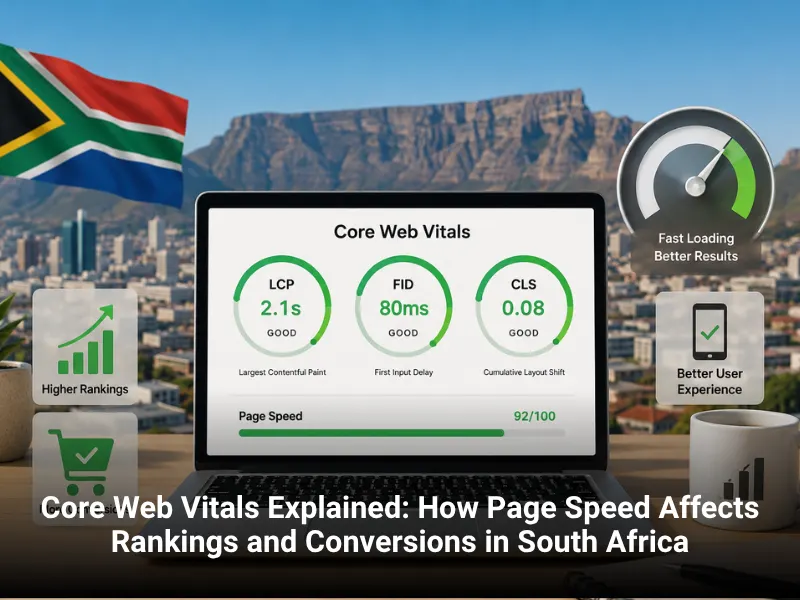

Core Web Vitals Explained: How Page Speed Affects Rankings and Conversions in South Africa
Core Web Vitals are three Google metrics, loading speed, interactivity, and visual stability, that measure real-world user experience and directly influence search rankings. A slow-loading or unstable website can lose both rankings and customers, and for South African businesses dealing with variable mobile data speeds, the impact is often bigger than owners realise.
If you've been told your website is "slow" but don't know what that actually means or how to fix it, this guide breaks it down in plain language.
What Are Core Web Vitals?
Core Web Vitals are a set of specific, measurable signals Google uses to judge how a real visitor experiences your page, not just whether it loads, but how it feels to use. They were introduced as part of Google's Page Experience update and remain a confirmed ranking factor in 2026.
There are three metrics, and each one measures a different part of the experience:
- Loading: how long the main content takes to appear
- Interactivity: how quickly the page responds when someone clicks or taps
- Visual stability: whether elements jump around while the page loads
Google measures these using real visitor data (not just lab tests), which means your actual audience's devices, connections, and behaviour shape your score.
The Three Metrics Explained
LCP (Largest Contentful Paint)
LCP measures how long it takes for the biggest visible element on the page, usually a hero image, banner, or headline, to fully load. A good LCP score is under 2.5 seconds. Anything between 2.5 and 4 seconds needs improvement, and anything over 4 seconds is considered poor.
LCP matters because it's the moment a visitor decides "this page is ready" or "this page is broken." A slow LCP is one of the fastest ways to lose a visitor before they've seen anything.
INP (Interaction to Next Paint)
INP measures how quickly your site responds after someone interacts with it, clicking a button, opening a menu, filling in a form. A good INP score is under 200 milliseconds. Between 200ms and 500ms is considered needs improvement, and above 500ms is poor.
INP replaced an older metric called FID (First Input Delay) as Google's standard interactivity measure. If your site "feels laggy" when someone taps something, INP is usually why.
CLS (Cumulative Layout Shift)
CLS measures how much content unexpectedly shifts around while a page loads. Think of a button moving just as someone goes to tap it, because an image or ad loaded late above it. A good CLS score is under 0.1. Between 0.1 and 0.25 needs improvement, above 0.25 is poor.
CLS is often the most frustrating issue for visitors because it directly causes mis-clicks, abandoned forms, and a sense that a site is untrustworthy or poorly built.
Why Page Speed Matters for South African Businesses
Page speed isn't just a Google ranking checkbox in South Africa, it's a direct cost to your visitors. Mobile data remains expensive relative to income here, and a large share of traffic still arrives over LTE rather than fibre-grade connections, particularly outside major metros. A page that loads acceptably on a European fibre line can feel genuinely broken on a South African mobile connection.
There's also a local infrastructure factor most businesses don't consider: load-shedding. Poor hosting setups without proper failover or caching can produce inconsistent load times or downtime during power cuts, which shows up in your Core Web Vitals data as instability even if the underlying code is fine. Where your site is hosted, and whether it's served through a content delivery network (CDN) with local edge locations, has a measurable effect on how South African visitors experience your pages, one of several current web development trends shaping how sites are built for South African audiences in 2026.
The business impact is straightforward: slower sites see lower conversion rates, higher bounce rates, and weaker rankings, compounding into fewer leads from both search and paid traffic.
How to Check Your Website's Core Web Vitals Score
You don't need to guess. Google provides free tools that show your actual scores:
- Google PageSpeed Insights: enter any URL and get an instant Core Web Vitals breakdown, plus specific fixes.
- Google Search Console: under the "Core Web Vitals" report, this shows real visitor data across your whole site, grouped by URL, so you can see which pages are struggling at scale.
- Chrome DevTools (Lighthouse): useful for developers testing changes before they go live.
Search Console is the most reliable source because it reflects real visitors on real South African connections, not a single lab test. If your scores are consistently poor across most pages, that's usually a sign the underlying build needs attention rather than a single quick fix, worth reading alongside our guide on how website development in Johannesburg works for growing businesses.
Common Causes of Poor Scores and How They're Fixed
Common Causes of Poor Scores and How They're Fixed
|
Problem |
Typical cause |
Fix |
|
Poor LCP |
Unoptimised images, slow hosting, render-blocking scripts |
Compress and resize images, use modern formats (WebP/AVIF), upgrade hosting or add a CDN |
|
Poor INP |
Heavy JavaScript, bloated plugins, third-party scripts (chat widgets, ad trackers) |
Remove unused plugins, defer non-essential scripts, minimise third-party embeds |
|
Poor CLS |
Images/ads without set dimensions, web fonts loading late, injected banners or popups |
Set explicit width/height on images, preload key fonts, reserve space for dynamic content |
Most WordPress sites in particular accumulate poor scores gradually. A plugin added here, a tracking script added there, rather than from one big mistake. That's why Core Web Vitals issues are usually best addressed as part of ongoing website maintenance rather than a single one-off fix. Our guide on what's included in website maintenance services in South Africa covers exactly this kind of ongoing performance monitoring.
Is Your Website Performing at Its Best?
Website performance issues can quietly affect search visibility, user experience, and conversions. Visitors expect pages to load quickly and work smoothly across every device. Best Web Design can help you identify performance gaps, understand your Core Web Vitals, and uncover areas that may be limiting your website’s SEO potential.
Get clear, practical recommendations to improve speed, usability, rankings, and overall website performance. Contact Us today to discuss your website and discover opportunities to improve its performance.