
Brand Authority vs Traffic in SEO: What Really Drives Revenue? (2026 Guide)
April 30, 2026
How ChatGPT is Changing Google Search and SEO in South Africa
May 12, 2026

How to Get Your Website in Google AI Overviews in 2026
What Are Google AI Overviews? (And Why They Matter in 2026)
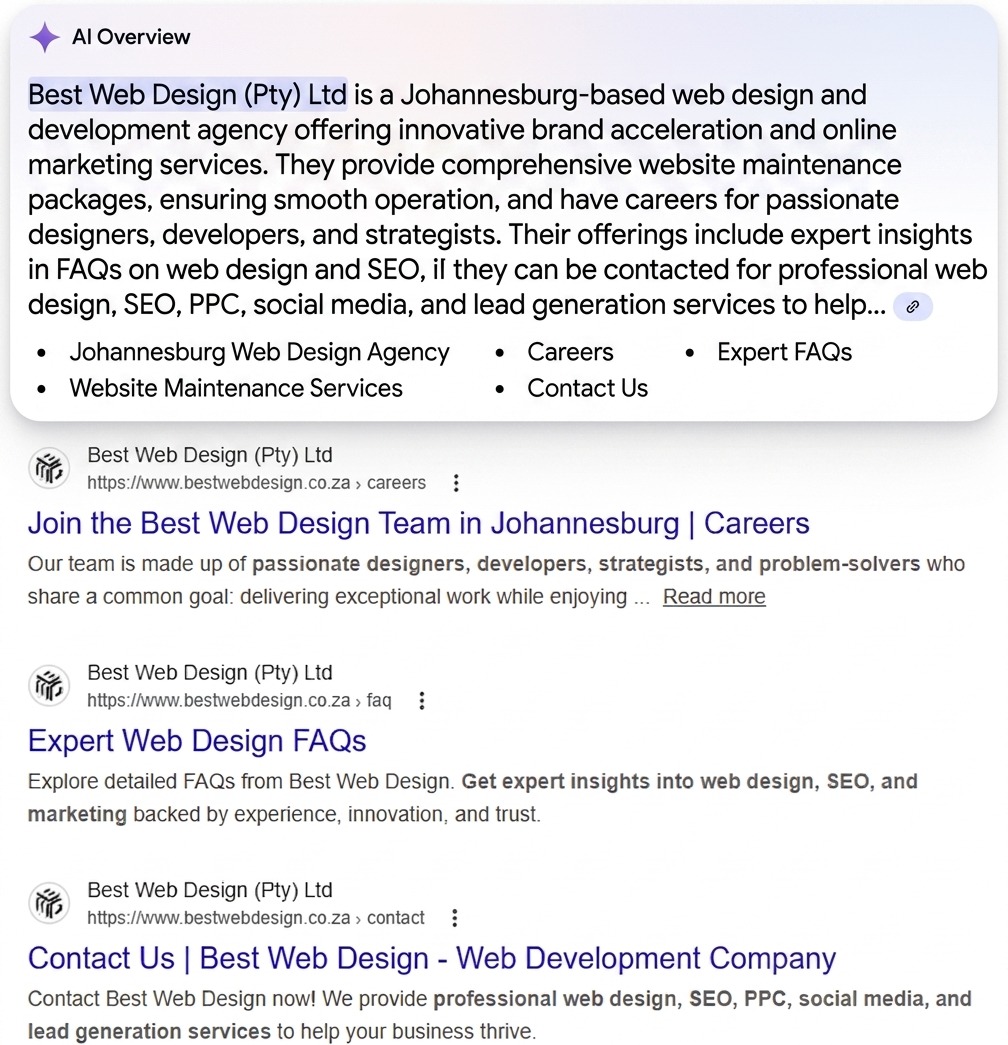
Google AI Overviews are AI-generated summary boxes that appear at the very top of Google search results above all organic listings, above paid ads, and above featured snippets. Google's AI reads content from multiple trusted websites, synthesises the most relevant information, and presents a concise answer directly on the search results page.
They were first rolled out globally under the name Search Generative Experience (SGE) and officially became "AI Overviews" in mid-2024. By 2026, AI Overviews will appear on an estimated 30–40% of all Google searches, particularly for how-to queries, definition questions, comparison searches, and local service questions.
AI Overviews vs Featured Snippets
|
Feature |
AI Overviews |
Featured Snippets |
|
Source |
Multiple websites |
Single page |
|
Format |
AI summary |
Extracted text |
|
Depth |
Detailed |
Short |
|
Visibility |
Very high |
High |
Why does this matter for your website?
There are two sides to this. Websites that are NOT cited in AI Overviews are seeing lower click-through rates on certain queries because users get their answer without clicking through. However, websites that ARE cited inside an AI Overview enjoy a significant brand authority boost, increased qualified traffic, and a strong trust signal because Google is essentially recommending them as a credible source.
In 2026, getting cited in Google AI Overviews is one of the most powerful organic visibility strategies available to South African businesses.
How Google Decides Which Websites to Feature in AI Overviews
Google AI Overviews is not random. Google uses a specific set of criteria to decide which websites deserve to be cited. Understanding these criteria is the foundation of your entire AI Overview strategy.
E-E-A-T: Experience, Expertise, Authority, and Trust
E-E-A-T is Google's quality framework for evaluating content. Google's Quality Rater Guidelines, the document that trains its AI, places E-E-A-T at the centre of every ranking decision. For AI Overviews specifically, E-E-A-T signals tell Google whether your content is trustworthy enough to show to millions of users as a direct answer.
- Experience means your content demonstrates real, first-hand knowledge of the topic. Include case studies, original data, client results, and personal insights.
- Expertise means the content is written by or attributed to a qualified person. A named author with a job title and a short bio signals credibility.
- Authority means other reputable websites link to and reference your content. Backlinks from respected South African websites (news outlets, industry directories, professional associations) build authority.
- Trust means your website is secure (HTTPS), has clear contact information, a physical address, and transparent business information.
Structured and Scannable Content
Google's AI crawls content looking for clear, direct answers. Pages written in dense paragraphs with no headings are difficult for the AI to parse. Structured content — with H1, H2, and H3 headings, numbered lists, definition paragraphs, and FAQ blocks — is significantly easier for Google's AI to extract and cite.
Schema Markup
Schema markup is code you add to your website that helps Google understand what your content is about. FAQPage schema, HowTo schema, and Article schema are the three most powerful types for getting cited in AI Overviews. We cover this in detail in Step 2 below.
Topical Authority
Topical authority means Google recognises your website as a credible, go-to source on a specific subject. If you have published multiple well-optimised articles on SEO, web design, and digital marketing and those articles link to each other Google starts to see your website as an authority hub on those topics. This is why a content cluster strategy is essential for sustained AI Overview visibility.
7 Proven Steps to Get Your Website Into Google AI Overviews
These seven steps are not theoretical. They are the practical, technical, and content-based actions that give your website the best possible chance of being cited in Google AI Overviews in 2026.
Step 1: Write a Direct Answer at the Top of Every Page and Section
Google's AI reads the first one to two sentences under every heading on your page. If those opening sentences directly answer a question without a long build-up or teaser the AI can extract and cite them immediately.
The formula to use: Start every H2 section with: "[Topic] is [definition]. [Why it matters]. [What to do about it]."
For example, instead of writing: "In this section, we are going to talk about E-E-A-T and what it means for your website..." — write: "E-E-A-T (Experience, Expertise, Authority, Trust) is Google's framework for evaluating content quality. It directly determines whether your page is trustworthy enough to appear in AI Overviews."
The second version answers the question in the very first sentence. That is what Google's AI is looking for.
Step 2: Add FAQ Sections with FAQPage Schema Markup
FAQ sections are the single most powerful content format for getting cited in Google AI Overviews. Here is why: when someone searches a specific question, Google's AI looks for the most direct, well-structured answer available and FAQ blocks written in a Q&A format are exactly that.
But the FAQ content alone is not enough. You must also add FAQPage JSON-LD schema markup to the code of your page. This schema tells Google: "These are questions and their exact answers." Google can then extract them precisely for AI Overviews, featured snippets, and People Also Ask boxes.
If your website runs on WordPress, the Rank Math or Yoast SEO plugins both generate FAQPage schema automatically when you use their FAQ content blocks. You do not need to write the code manually.
Add 5–8 FAQ questions per service page and blog post. Make sure each answer is 40–80 words specific enough to be useful, short enough to be extracted cleanly.
Step 3: Build Topical Authority with a Content Cluster
A content cluster is a group of related articles that all link to each other and to one central "pillar" page. For example, if your pillar page is "SEO Services in Johannesburg," your cluster articles might include:
- How to Rank in Google AI Overviews in 2026 (this article)
- AI SEO vs Traditional SEO: Key Differences in 2026
- How to Structure a Service Website for Google AI Overviews
- Why Your Website Gets Traffic But No Leads
When these articles are interlinked and all cover related subtopics, Google begins to see your website as a topical authority on SEO and web design. Once that authority is established, every new article you publish on these topics has a significantly higher chance of appearing in AI Overviews.
Step 4: Use a Clear Heading Structure (H1 → H2 → H3)
Your heading structure is like a table of contents for Google's AI. A clear, logical heading hierarchy tells the AI exactly how your content is organised and which sections answer which questions.
Every blog post and service page should follow this structure:
- One H1 tag — your main title (e.g., "How to Get Your Website in Google AI Overviews in 2026")
- Multiple H2 tags — your main sections (e.g., "What Are Google AI Overviews?")
- H3 tags under each H2 — your sub-points and step breakdowns
Never skip heading levels (jumping from H1 to H3). Never use more than one H1 per page. And critically — make sure your H1 is a static HTML element, not buried inside a JavaScript slider or plugin, where Google's crawler may not be able to read it reliably.
Step 5: Earn Backlinks from Trusted South African Websites
For local South African rankings, backlinks from .co.za domains, South African media outlets, and local professional directories carry disproportionate weight. Generic international backlinks do far less for your local visibility than a single link from a respected SA publication.
Practical backlink strategies for South African businesses:
- Contribute a guest article to MyBroadband.co.za or Entrepreneur.com/za on a topic in your area of expertise
- List your business on the South African Chamber of Commerce directory and Hotfrog.co.za
- Add a discreet "Website designed by Best Web Design" credit link on client websites (with their permission)
- Sponsor a local business event or award and get a mention on their website
Each backlink from an authoritative South African domain strengthens your site's overall authority—which directly improves your chances of being cited in AI Overviews.
Step 6: Optimise for Core Web Vitals (Page Speed Matters)
Google has used Core Web Vitals as a ranking signal since 2021, and in 2026 they are more important than ever. A slow website—even one with excellent content—is less likely to appear in AI Overviews because Google prioritises pages it can crawl quickly and that provide a good user experience.
The three Core Web Vitals to optimise are:
- LCP (Largest Contentful Paint): How fast your main content loads. Target: under 2.5 seconds.
- CLS (Cumulative Layout Shift): How much your page visually shifts while loading. Target: below 0.1.
- INP (Interaction to Next Paint): How quickly your page responds to user input. Target: under 200ms.
Test your website right now using Google's free PageSpeed Insights tool (pagespeed.web.dev). Pay special attention to your mobile score — the majority of South African internet users browse on mobile devices, and Google indexes the mobile version of your site first.
Common culprits for slow South African websites: unoptimised images, heavy page builder plugins, too many JavaScript plugins, and web hosting servers based outside of South Africa with high latency.
Step 7: Add a Named Author Bio with Credentials
One of the most overlooked and most impactful changes you can make is replacing a generic author name like "Admin" or "BWD Admin" with a real, named author profile.
Google's Helpful Content system and E-E-A-T guidelines specifically reward content that demonstrates real human expertise. A named author with a photo, a job title, a two-line bio, and a LinkedIn profile link tells Google, "A qualified person wrote this. It is trustworthy."
For your SEO and web design blog posts specifically, the author should be your lead SEO strategist or web designer, someone whose credentials are directly relevant to the content topic. This single change can meaningfully improve both your AI Overview citation rate and your overall search rankings.
What Types of Content Google AI Overviews Prefer
Not all content formats are equally likely to be cited. After analyzing thousands of AI overview citations, a clear pattern emerges: Google's AI strongly prefers content that is structured, specific, and directly answerable.
|
Content That Gets Cited |
Content That Gets Ignored |
|
Direct definition paragraphs |
Long introductions with no clear answer |
|
Numbered step-by-step lists |
Dense blocks of unbroken text |
|
FAQ blocks with schema markup |
Generic advice without specific detail |
|
Comparison tables |
Keyword-stuffed thin content |
|
Statistic-backed claims with sources |
Outdated content with no publication date |
|
Named author with credentials |
Anonymous "Admin" authorship |
The most consistently cited content type across AI Overviews is the numbered list. When you break a complex topic into 5, 7, or 10 clearly numbered steps and each step starts with a direct action, Google's AI can extract individual steps cleanly and present them as a structured summary.
Common Mistakes That Stop Your Website from Appearing in AI Overviews
Knowing what to do is important. But knowing what NOT to do can save you months of wasted effort.
Mistake 1: No schema markup. If your website has no structured data, Google's AI has to guess what your content is about. Schema markup removes the guesswork. Every service page and blog post should have Article schema at minimum, with FAQPage schema on any page that includes Q&A content.
Mistake 2: Thin content under 600 words. Google will not cite a 300-word page in an AI Overview. Thin content signals low value and low effort. Every page targeting a competitive keyword needs a minimum of 800 words — and blog posts targeting informational queries should aim for 1,500–2,500 words.
Mistake 3: No author credentials. Publishing under "Admin" is the fastest way to lose E-E-A-T points. Named, credentialed authors are now a direct signal in Google's content quality assessment.
Mistake 4: Slow page speed on mobile. If your page takes more than 4 seconds to load on mobile, Google is far less likely to surface it in AI Overviews — regardless of how good the content is.
Mistake 5: Copying content from other websites. Duplicate or near-duplicate content is actively penalised. Every page on your website must be original, first-hand, and written specifically for your target audience. Google's AI is remarkably effective at identifying recycled content.
Conclusion: Your Next Steps to AI Overview Visibility
Google AI Overviews are not a trend — they are the new reality of search in 2026. For South African businesses, the opportunity is significant: most local competitors have not yet optimised their websites for AI Overview visibility, which means early movers stand to gain substantial ground.
To summarise the seven steps that will get your website featured:
- Write a direct answer in the first sentence of every section
- Add FAQPage schema markup to every blog post and service page
- Build a content cluster around your core service topics
- Use a clean H1 → H2 → H3 heading structure
- Earn backlinks from trusted South African websites and directories
- Achieve a PageSpeed Insights mobile score above 80
- Publish under a named author with visible credentials and a bio
Each of these steps compounds on the others. The more of them you implement together, the faster and more consistently your website will appear in Google AI Overviews.
Ready to get your South African website optimised for Google AI Overviews?
At Best Web Design, our SEO team in Johannesburg specialises in building AI-ready content strategies for South African businesses. From technical schema implementation to full content cluster planning, we do the heavy lifting so you can focus on running your business.
Book your free SEO consultation today and let's get your website into Google AI Overviews in 2026.