
Web Development Company Services: From Custom Websites to Web Applications
August 20, 2026
SEO Company Johannesburg: Technical SEO, Content & Local Search Explained
August 31, 2026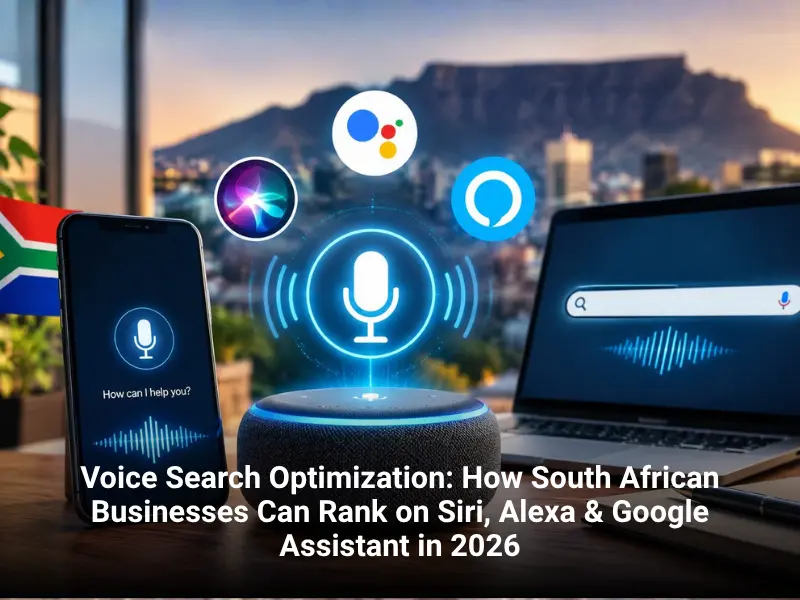

Voice Search Optimization: How South African Businesses Can Rank on Siri, Alexa & Google Assistant in 2026
Voice search optimization means structuring website content to answer the longer, conversational questions people ask Siri, Alexa, and Google Assistant, as opposed to the shorter keyword phrases used in typed search. It relies heavily on featured snippets, structured data, and direct question-and-answer formatting.
If you've already worked on getting your content into Google AI Overviews or optimized for tools like ChatGPT and Gemini, voice search is a related but separate discipline. Those platforms generate written answers to typed prompts. Voice search optimization is about spoken queries answered out loud, often with no screen involved at all. Different behavior, different formatting rules, and for South African businesses, a different local search layer entirely.
What Is Voice Search and How It Differs From Typed Search
Voice search lets someone ask a question out loud to a device, phone, or smart speaker instead of typing it into a search bar. The core difference isn't the technology. It's the phrasing.
Typed search tends to be short and fragmented: "plumber Sandton prices." Voice search tends to be a full sentence: "Who's a reliable plumber near me in Sandton and what do they charge?"
This matters because ranking for "plumber Sandton" and ranking for that spoken question require different content structures. Voice search SEO in South Africa means writing for how people actually talk, not just how they type. That includes:
- Full questions rather than keyword fragments
- Natural, everyday phrasing (including local expressions)
- Longer-tail queries with more specific intent
- A conversational tone in headings and answers, not just body copy
Voice assistants also skew toward giving one answer rather than a list of ten blue links. That single-answer format is why structured, direct content matters so much more here than in traditional SEO, and why entity SEO has become such a central piece of ranking well across Google, voice assistants, and AI tools alike.
Why Voice Search Optimization Still Matters in 2026
Voice search adoption in South Africa has grown steadily as smartphone penetration, data affordability, and smart speaker use have all increased. But the bigger shift isn't just more people using voice, it's how voice assistants source their answers.
Siri, Alexa, and Google Assistant increasingly pull responses from the same structured, well-marked-up content that AI Overviews and generative answer engines favor. A page written to directly answer a specific question doesn't just have a shot at ranking in Google's featured snippet, it also has a shot at being read aloud by a smart speaker, surfaced in an AI Overview, and cited by a generative AI tool. One well-structured page, three different exposure channels.
For local South African businesses, this compounds with mobile-first behavior. Voice queries are disproportionately local ("near me," "open now," "closest to me") and disproportionately mobile, which means voice search optimization and local SEO are no longer separate projects. They overlap almost completely.
How Voice Assistants Choose an Answer
Voice assistants don't crawl the web live and read out whatever ranks first. They pull from a narrower set of sources: featured snippets, knowledge panels, structured data, and (for local queries) business listing platforms like Google Business Profile.
The process generally works like this:
- The assistant parses the spoken query into a search intent.
- It looks for a single best-match answer, usually from content that's already winning the featured snippet or has strong schema markup.
- For local intent ("near me," "open now," "best in [city]"), it leans heavily on business profile data: location, hours, ratings, and category.
- It reads back a short, spoken-length answer, often just one or two sentences, sometimes with a follow-up prompt.
There's no list of ten options read aloud. There's one winner. That's what makes voice search optimization higher stakes than typical SEO: you're not competing for a spot on page one, you're competing to be the single answer spoken back.
Featured snippets and structured data's role
Featured snippets are the single biggest predictor of whether a page gets used as a voice answer. Google's assistant in particular tends to read out the snippet-winning content almost verbatim, so if your page already holds a snippet for a query, it has a strong chance of being read aloud for the voice version of that same query.
Structured data (schema markup) helps assistants understand what your content actually is, not just what it says. FAQPage schema, LocalBusiness schema, and Review schema all give voice assistants clean, unambiguous data to pull from instead of trying to parse meaning out of plain paragraphs. If you haven't added schema markup to your key pages, this is the single highest-leverage technical fix for voice search readiness.
Optimizing Content for Conversational Queries
Ranking for conversational queries means writing content the way your customers actually ask questions, not the way keyword tools shorten them.
A few practical shifts:
- Target full questions, not fragments. Instead of optimizing for "web design cost," build a section around "How much does web design cost in South Africa?"
- Answer first, explain after. Open with a direct, spoken-length answer (one sentence, ideally under 30 words), then expand with detail underneath. Voice assistants read the first clear answer they find, not the most thorough one.
- Use natural language in headings. H2s and H3s phrased as questions ("What's the difference between voice search and text search?") are more likely to be matched to spoken queries than headings phrased as topics ("Voice vs. Text Search").
- Write for long-tail, specific intent. Conversational queries are longer and more specific by nature. "Best affordable web designer for small business in Cape Town" will out-perform generic content built only around "web designer Cape Town."
- Keep spoken answers short. Assistants generally read back short responses. If your answer to a question runs several paragraphs before it says anything direct, restructure it so the direct answer comes first.
This is also where voice search SEO and AI Overview optimization genuinely reinforce each other. Both reward clear, direct, well-structured answers over dense, keyword-stuffed paragraphs.
Local Voice Search: "Near Me" Queries for South African Businesses
A large share of voice queries carry local intent, and for South African businesses this is where voice search optimization has the clearest return. Someone asking their phone "What's the best web design company near me in Johannesburg?" isn't browsing. They're close to a decision.
Your Google Business Profile is the backbone of local voice results. When someone asks a "near me" question, Google Assistant leans on Business Profile data (business category, location, hours, and review signals) far more than on your website content. That means:
- Your Google Business Profile needs to be complete, accurate, and actively maintained, not just claimed and forgotten.
- Business categories need to match the actual services people ask about by voice.
- Hours of operation need to be current. Assistants routinely get asked "is [business] open now," and a wrong answer costs you the visit.
- Reviews matter more here than almost anywhere else. Voice assistants often factor review volume and rating into which local business gets named as "the best." Building a steady flow of Google reviews feeds directly into this.
If you've already built out your Google Business Profile and Google reviews strategy, voice search optimization isn't a new project, it's the next layer on top of work you've already started. If you haven't, "near me" voice queries are a strong reason to prioritize it now.
Ready to Be the Answer, Not Just a Result?
Voice search, AI Overviews, and generative answer engines all reward the same thing: clear, structured, genuinely helpful content backed by a strong local presence. If your website isn't set up to answer questions directly, or your Google Business Profile isn't pulling its weight, you're handing those "near me" queries straight to a competitor. Get a free voice/AI search readiness audit from Best Web Design and find out exactly what's holding your content back from being the answer Siri, Alexa, and Google Assistant read out loud. Book your free audit today.