
Landing Page Design That Converts: A Practical Guide for South African Businesses
September 21, 2026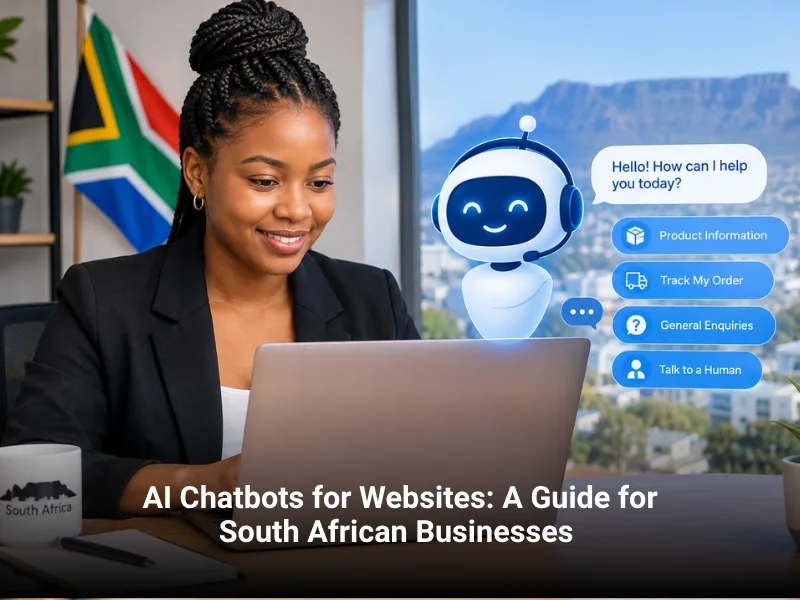
AI Chatbots for Websites: A Guide for South African Businesses
An AI chatbot for websites is a software tool that uses natural language processing to answer visitor questions, qualify leads, and provide support automatically, without a human agent typing every reply. For South African businesses, this means round the clock engagement with website visitors even outside normal Johannesburg business hours. The right chatbot can turn casual browsers into booked consultations or completed sales without adding to your team's workload.
What Is an AI Chatbot for a Website?
An AI chatbot for a website is a program embedded in a site that holds real time conversations with visitors using natural language processing (NLP) rather than rigid scripted menus. Unlike the old "click a button to choose an option" bots, modern AI chatbots understand intent, context, and phrasing variations, so a visitor typing "how much does a website cost" and "what are your pricing options" both get a relevant answer.
Most website chatbots today are built on large language models, similar technology to what powers tools like ChatGPT, but trained or configured with a business's own information: services, FAQs, pricing structure, and tone of voice.
How Are AI Chatbots Different From Live Chat?
Live chat connects a visitor to a human agent typing in real time, while an AI chatbot answers automatically using pre-trained knowledge and conversation logic. Live chat depends on staff availability; an AI chatbot works at 2am on a Sunday just as well as midday on a Tuesday. Many South African businesses now combine both: chatbot first, human handoff for complex queries.
How Does an AI Chatbot for a Website Work?
An AI chatbot works by processing a visitor's typed message, matching intent against a trained knowledge base, and generating a relevant response, often within a second or two. The process generally follows these steps:
- The visitor sends a message through a chat widget on the website.
- The chatbot processes the text using NLP to identify what the visitor actually wants.
- It searches its knowledge base (FAQs, product data, service pages, or a connected database) for the best match.
- It generates or selects a response, sometimes pulling in live data like stock availability or booking slots.
- It escalates to a human if the query is too complex, sensitive, or outside its training.
- It logs the conversation, which can feed into a CRM or reporting dashboard for follow-up.
This is where good data analytics matters. Chatbot conversation logs reveal exactly what your visitors are struggling to find or asking about most, which is valuable input for refining both your website and your marketing.
Why Do South African Businesses Need an AI Chatbot?
South African businesses benefit from AI chatbots because local consumers increasingly expect instant digital responses, yet many companies still rely on email or phone lines that only operate during business hours. Load shedding, traffic, and long commute times in cities like Johannesburg also mean staff aren't always at their desks to respond immediately, while a chatbot never goes offline because of a power cut on the front end (assuming your hosting has proper backup infrastructure).
South African online shopping and service enquiry behavior has shifted heavily toward mobile browsing, and visitors expect a WhatsApp-style, conversational experience rather than filling out a static contact form. A chatbot bridges that gap directly on your website.
What Business Problems Does a Chatbot Solve?
A chatbot solves the core problem of lost leads from slow response times, since studies consistently show that responding to a web enquiry within minutes rather than hours dramatically increases conversion rates. Beyond speed, chatbots also solve:
- After hours coverage for enquiries that come in at night or over weekends
- Repetitive question fatigue, freeing staff from answering the same five questions daily
- Inconsistent messaging, since a chatbot gives the same accurate answer every time
- Lead qualification, filtering serious enquiries from casual browsers before a salesperson gets involved
This directly supports lead generation efforts, since a chatbot can capture contact details and qualify interest before a lead even reaches your inbox.
AI Chatbot vs Traditional Contact Form: Which Converts Better?
An AI chatbot typically converts better than a static contact form because it engages visitors immediately and interactively, rather than asking them to fill in fields and wait for a reply. The comparison below breaks down the key differences:
|
Feature |
AI Chatbot |
Contact Form |
|
Response time |
Instant |
Hours to days |
|
Availability |
24/7 |
Business hours (staff-dependent) |
|
Visitor engagement |
Interactive, conversational |
Passive, one-directional |
|
Lead qualification |
Can ask follow-up questions live |
None until manual follow-up |
|
Abandonment rate |
Lower (feels like a conversation) |
Higher (feels like a task) |
|
Setup effort |
Moderate (needs training/config) |
Low |
Neither has to replace the other. Many websites keep a contact form for formal enquiries while using a chatbot for immediate questions, quotes, and simple bookings.
What Should a South African Business Look for in a Chatbot Platform?
A South African business should prioritize a chatbot platform that integrates with WhatsApp, supports local business hours and public holidays, and connects to existing tools like Google Business Profile and CRM systems. Key things to check before choosing a platform:
- WhatsApp integration, since WhatsApp is the dominant messaging app for South African consumers
- Local relevance in training data, so the bot understands South African terms, ZAR pricing formats, and regional service areas
- CRM and email marketing integration, so captured leads flow directly into your existing systems
- Human handoff options, so complex or sensitive queries reach a real person
- Mobile responsiveness, since most South African web traffic is mobile-first
A chatbot that captures a lead is only half the job. That lead needs to move into a proper follow-up sequence, which is where email marketing automation picks up the relationship.
How Do You Add an AI Chatbot to an Existing Website?
Adding an AI chatbot to an existing website usually involves choosing a platform, training it on your business content, and embedding a small script into your site's code, a process that can take anywhere from a few hours to a few weeks depending on complexity. For most small to medium businesses, the practical route is:
- Define what the chatbot needs to handle (FAQs, bookings, product queries, support)
- Choose a platform that fits your budget and technical setup
- Feed it your service pages, FAQs, and common customer questions
- Test it thoroughly with real staff before launch
- Monitor conversations weekly and refine its answers
If your website's current structure or codebase makes this difficult, that's usually a sign it needs updating rather than the chatbot being the wrong choice. Solid website design and development makes chatbot integration far smoother, and ongoing website maintenance keeps the integration stable as browsers and platforms update.
For e-commerce specifically, chatbots can handle order status queries, product recommendations, and cart abandonment recovery directly on-site, a natural extension of good e-commerce website design. This pairs well with lead capture strategies covered in our post on lead generation strategies for South African businesses.
Does an AI Chatbot Help With SEO?
An AI chatbot does not directly improve search rankings, but it supports SEO indirectly by improving on-site engagement metrics like time on page and reducing bounce rate, both of which search engines associate with a good user experience. A chatbot that answers questions well also keeps visitors on your site longer instead of bouncing back to Google to search elsewhere, and better content structure across your site (the kind covered in our content marketing strategy guide) gives a chatbot more accurate material to draw from. If SEO performance is a concern alongside chatbot adoption, it's worth reviewing your site holistically with a proper SEO audit.
Ready to Add a Chatbot to Your Website?
If your website could be doing more to engage visitors and capture leads outside office hours, it might be time to look at how a chatbot fits into your overall online marketing strategy. Get in touch to talk through what would actually work for your site and your customers.