

E-commerce Website Design: How to Build an Online Store That Converts in South Africa
September 7, 2026
Landing Page Design Best Practices to Increase Conversions in South Africa
September 11, 2026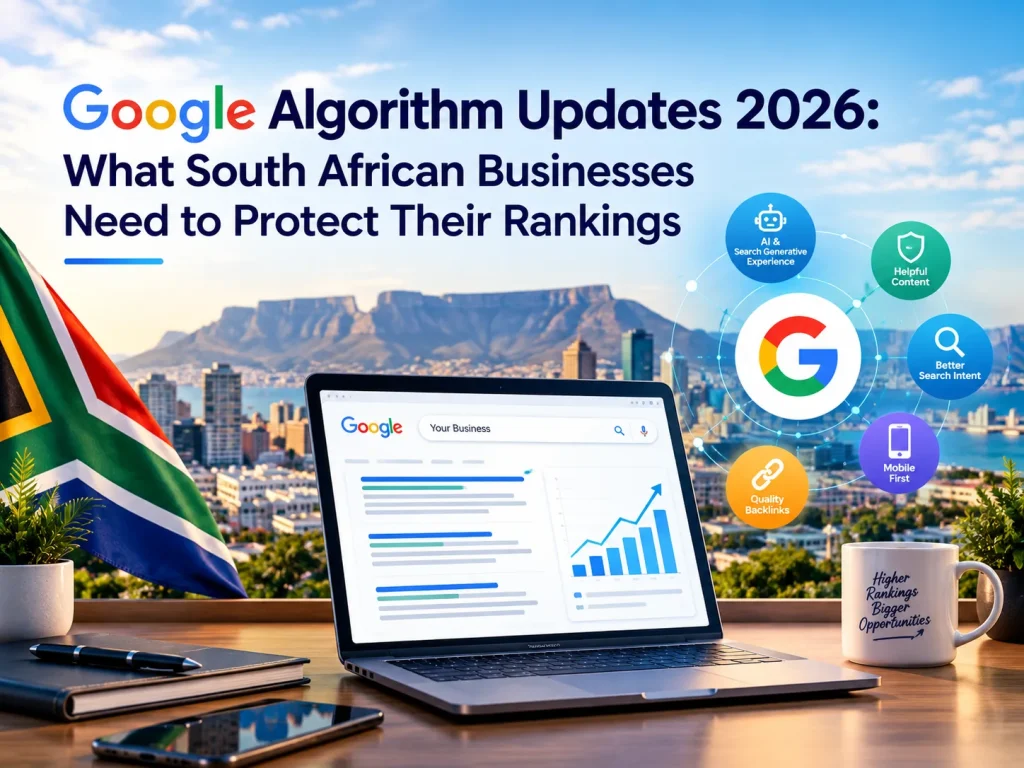
Google Algorithm Updates 2026: What South African Businesses Need to Protect Their Rankings
Google's 2026 algorithm updates have focused on rewarding original, people-first content with strong E-E-A-T signals, while pushing down thin, AI-scaled, and spam-driven pages. If your rankings shifted this year without you changing anything, one of these updates is the most likely reason, and the fix is almost always the same: build genuine expertise and trust into your content rather than chasing a single technical trick.
What Google algorithm updates are and why they happen
Google doesn't rank websites with one fixed formula. It runs thousands of small adjustments to its search systems every year, most of which go unnoticed. A handful of times a year, though, Google rolls out a broader change, a core update or a spam update, that can shift rankings noticeably for many sites at once.
Google confirmed five algorithm updates between February and June 2026 alone, and more followed later in the year. Spam updates specifically target sites using manipulative tactics, such as publishing large volumes of low-effort pages purely to capture traffic, buying placement on other trusted sites to borrow their credibility, or running fake review schemes. Core updates work differently. They are broader reviews of content quality across the whole of Google search, so even a site doing nothing wrong can see movement if its content quality hasn't kept pace with what's now considered helpful.
For South African businesses, this matters because a ranking drop rarely means Google is "punishing" a site. More often it means competitors, or the bar for quality generally, have moved forward while a site's content has stayed still.
Key themes in 2026 updates: helpfulness, experience and trust
Three themes have run through this year's changes.
Core updates rewarded topical authority and freshness. The May 2026 core update reinforced trends already visible earlier in the year, with topical authority, content freshness, and strong E-E-A-T signals playing a greater role in rankings. Businesses publishing regularly updated, expert-led content generally weathered the update better than sites that hadn't reviewed their content in months or years.
Spam updates targeted scaled, low-value content. The pattern has continued into the second half of the year, with pages showing weak originality, thin evidence, or vague search intent losing more visibility than pages offering clear value. Sites relying on mass-produced or AI-generated pages with little original insight have been the most exposed.
Site experience kept mattering. Sites with strong Core Web Vitals scores gained noticeably more traffic through the year's updates, while scaled content abuse and expired, repurposed domains lost visibility. Speed and usability aren't a separate box to tick anymore. They're part of the same quality signal Google is measuring alongside content itself.
How to tell if an algorithm update affected your rankings
A ranking change isn't always down to Google. Seasonal demand, a site redesign, or a competitor's new content can all move the needle too. Before assuming an update is to blame, check the timing and pattern of the drop against what actually happened on your site.
Reading Google Search Console data after an update
Search Console is the most reliable place to confirm what happened, because it shows your site's actual performance rather than third-party estimates.
- Check the Performance report and compare clicks and impressions over the weeks around a known update's rollout date, not just a single day.
- Look at whether the drop is spread across many pages and queries, which points to a broader update, or concentrated on a few pages, which often points to a content or technical issue specific to that page.
- Review the Coverage and Core Web Vitals reports for the same period to rule out a crawling, indexing, or speed problem that coincided with the update by chance.
- Compare the affected pages against your site's most recently updated content. Pages that haven't been touched in over a year are the most common casualties of core updates.
What still matters regardless of individual updates
Chasing each individual update announcement is less useful than building a site that holds up against all of them. A few fundamentals have stayed constant through every update in 2026.
Original content, site experience, and E-E-A-T signals
Content that reflects real, first-hand knowledge of a subject continues to outperform generic or templated writing, particularly once a site covers a topic in enough depth to demonstrate genuine expertise. This is the same E-E-A-T framework, Experience, Expertise, Authoritativeness and Trustworthiness, that shapes how Google's quality raters assess pages, and it increasingly overlaps with how AI Overviews and other AI search tools decide which sources to cite. Our earlier guide, How E-E-A-T Impacts SEO, AI Search & Google Rankings in 2026, covers this framework in more depth if you want a fuller breakdown of each component.
Alongside content quality, a fast, stable, mobile-friendly site remains a baseline requirement rather than a bonus. Businesses that treat Core Web Vitals as a one-time fix rather than an ongoing standard tend to be the ones caught out when a core update rolls through.
Recovery steps if your rankings dropped
If you've confirmed an update is behind a drop, recovery is rarely instant, but it is usually achievable with a clear, honest audit.
- Identify the specific pages and queries that lost visibility, using the Search Console data from the previous section rather than guesswork.
- Review those pages against current search intent. Has the type of content Google shows for that query changed, from a list to a guide, for example, or from a product page to a comparison page?
- Strengthen thin or outdated pages with more original detail, updated information, and clearer evidence of expertise, rather than adding more keywords to the same content.
- Check technical health: page speed, mobile usability, broken links, and any spam signals such as unusual outbound links or duplicated content across pages.
- Give it time. Core update effects can take several weeks to fully settle, and re-crawling and re-evaluation of updated pages isn't immediate.
How South African businesses can stay ahead of future updates
Google will keep updating its systems, so the more useful goal is building a site that doesn't need to react to every headline. Review your most important pages on a set schedule rather than only after a drop. Keep content genuinely useful to the person reading it first, with keywords and structure supporting that rather than driving it. Maintain the technical basics, speed, mobile experience, and clean site structure, as ongoing maintenance rather than a once-off project. And keep an eye on how your content performs not just in traditional search results but in AI Overviews and other AI-generated answers, since the same quality signals increasingly determine visibility in both.
Keep your rankings resilient, whatever Google changes next
Algorithm updates will keep coming, but a site built on real expertise, clear structure, and solid technical health tends to weather them without drama. If you're not sure whether a recent update affected you, or your content hasn't been reviewed in a while, our SEO Company Johannesburg team can run a full audit and show you exactly where the opportunity is. For a deeper look at how technical SEO, content, and local search work together, read our guide on SEO Company Johannesburg: Technical SEO, Content & Local Search Explained.
If your traffic has dropped and you're not sure why, don't wait for the next update to make it worse. Book a free consultation with our team and we'll walk through your Search Console data with you, pinpoint what's actually happening, and set out a clear plan to get your rankings moving in the right direction again.