
How ChatGPT is Changing Google Search and SEO in South Africa
May 12, 2026
UX vs UI: Which Improves Conversions and Revenue?
May 18, 2026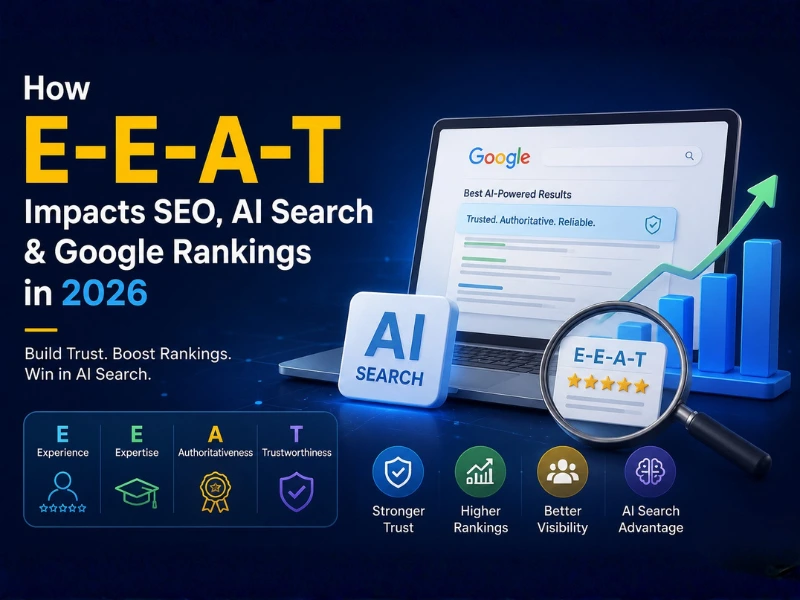

How E-E-A-T Impacts SEO, AI Search & Google Rankings in 2026
What is E-E-A-T in SEO?
E-E-A-T stands for Experience, Expertise, Authoritativeness, and Trustworthiness. It is a framework that Google's human search quality raters use to evaluate the quality of web pages and the content on them. These evaluations inform Google's machine learning systems and ultimately influence how pages rank in search results.
Google introduced E-E-A-T as part of its Search Quality Rater Guidelines, a document used by thousands of human contractors who assess whether Google's ranking algorithms are producing high-quality results. While E-E-A-T itself is not a direct ranking factor with a measurable score, it reflects the qualities that Google's core algorithm actively rewards through its various signals and updates.
Understanding E-E-A-T means understanding what Google considers a high-quality, trustworthy page. And in 2026, with AI overviews pulling content directly into the search results page, only the most credible sources are getting cited and featured.
The Four Pillars of E-E-A-T Explained
Let us break down each of the four E-E-A-T components and what they mean for your website.
Experience
Does the creator have first-hand, real-world experience with the topic? Google looks for personal experience signals such as original photos, case studies, first-person accounts, and product reviews from actual users.
Expertise
Does the author have formal knowledge, credentials, or demonstrated skill in the subject area? For medical or legal content, this often means verified professional qualifications.
Authoritativeness
Is your website and its authors recognized as authoritative sources in your niche? This is reflected through backlinks from reputable sites, brand mentions, and citations across the web.
Trustworthiness
The most important pillar. Google assesses whether your website is safe, honest, and reliable. This includes HTTPS, clear contact information, accurate content, transparent authorship, and positive reviews.
Google's guidelines specifically state that Trust is the most important of the four pillars. A website can have high expertise but still fail on trust if it lacks transparency, publishes misleading information, or does not clearly identify who is responsible for the content.
E-E-A-T vs E-A-T: What Changed and Why It Matters
Before December 2022, Google's quality framework was called E-A-T (Expertise, Authoritativeness, Trustworthiness). Google then added the first "E" for Experience, making it E-E-A-T. This was a significant shift that many website owners still do not fully understand.
The addition of Experience was Google's response to a major problem: content farms and AI-generated articles were producing technically accurate content written by people with zero real-world experience with the subject. A travel blog written by someone who has never visited a destination, or a product review written by someone who has never used the product, may have expertise on paper but lacks genuine firsthand experience.
Key insight for 2026: With the explosion of AI-generated content, Google's Experience signal has become even more critical. Demonstrating that your content comes from real, lived experience is now one of the most powerful ways to differentiate your website from AI-written content that floods the internet.
The practical difference for content creators is clear. Under the old E-A-T model, a well-researched article from a credentialed expert was enough. Under E-E-A-T, Google also wants to see signals that the author has genuinely engaged with the topic in the real world. This means including original photographs, personal anecdotes, case study data from your own work, and honest opinions based on direct experience.
How E-E-A-T Affects Google Rankings in 2026
One of the most common questions in the SEO community is: "Is E-E-A-T a direct ranking factor?" The technically accurate answer is no, E-E-A-T is not a single algorithmic signal. However, the qualities that E-E-A-T represents are deeply embedded across dozens of Google's ranking systems.
Here is how E-E-A-T signals translate into actual ranking factors that Google's algorithm measures:
- Backlink profile: High-quality backlinks from authoritative websites in your niche directly signal authoritativeness to Google. A link from a major news outlet or industry publication carries far more weight than hundreds of links from low-quality directories.
- Author credibility signals: Google can now associate content with specific authors across the web. An author bio page with verifiable credentials, social media profiles, and linked published work significantly boosts your E-E-A-T profile.
- Content depth and accuracy: Pages that comprehensively cover a topic with accurate, verifiable information rank higher than thin content. Google uses its Knowledge Graph to cross-reference factual claims.
- User experience signals: Bounce rate, time on page, and Core Web Vitals all feed into trust signals. A fast, well-structured, easy-to-navigate website signals that it is built for users, not just for search engines.
- Brand mentions and citations: Even unlinked brand mentions across the web (known as implied links) help Google understand that your brand is recognized and talked about in your industry.
- User reviews and ratings: Google actively indexes reviews from Google Business Profile, Trustpilot, G2, and other platforms. A strong review profile builds Trust signals that Google factors into local and general rankings.
E-E-A-T and Google AI Overviews in 2026
This is where E-E-A-T becomes especially exciting and important for content creators in 2026. Google's AI Overviews (previously known as Search Generative Experience) now appear at the top of search results for a large percentage of queries. These AI-generated summaries pull content directly from web pages and cite their sources visibly.
Getting cited in an AI Overview is one of the most valuable forms of visibility in modern SEO. And the pages that get cited most consistently share one common characteristic: they demonstrate strong E-E-A-T signals.
"In 2026, E-E-A-T is not just about ranking on page one. It is about being trusted enough that Google's AI system reads your content and recommends it to every user who asks a relevant question."
To maximize your chances of appearing in Google AI Overviews, focus on these specific strategies:
- Write concise, factually dense answers: AI Overviews prefer content that directly and clearly answers a question. Use structured paragraphs where the first sentence states the answer and the following sentences provide context and detail.
- Use FAQ sections with schema markup: Structured question and answer content is heavily favored by Google's AI for Overview citations. Add FAQPage schema to any question-and-answer content on your page.
- Include original data and research: Google's AI is much more likely to cite a page that contains proprietary data, statistics, or original research because these pages add genuine value that cannot be found elsewhere.
- Establish topical authority: Websites that publish deep, comprehensive content on a specific topic cluster are far more likely to be cited across multiple AI Overview results than general websites that publish a little bit of everything.
E-E-A-T for YMYL Pages: Why the Stakes Are Higher
YMYL stands for "Your Money or Your Life." These are pages where the content could directly impact a reader's health, financial wellbeing, safety, or major life decisions. Google applies its most rigorous E-E-A-T standards to YMYL content because the potential harm from inaccurate or misleading information is significant.
YMYL categories include health and medical information, financial advice and investment content, legal guidance, news and current events, safety information, and content related to major life decisions such as parenting, education, or housing.
If your website operates in any of these categories, here is what Google expects at a minimum. Your authors must have verified, demonstrable credentials in their field. Content must be regularly reviewed and updated to ensure accuracy. Medical or legal claims must be sourced to authoritative references. The website must clearly display who is responsible for the content, including contact information and a detailed About page.
How to Improve E-E-A-T for Your Website: A Practical Checklist
Improving your E-E-A-T score is not about gaming the algorithm. It is about genuinely becoming a more credible, authoritative, and trustworthy source in your field. Here is a practical, actionable checklist organized by each E-E-A-T pillar.
Improving the Experience Signal
- Include original photographs, videos, or screenshots that prove first-hand experience with the topic
- Add personal case studies, results from your own experiments, or real client outcomes
- Write honest product reviews that include both positive and negative observations
Improving the Expertise Signal
- Create a dedicated author bio page for every writer on your website, listing credentials, qualifications, and areas of specialization
- Link author bios to verified social media profiles, LinkedIn pages, and other published work
- Have medical, legal, or financial content reviewed and signed off by certified professionals
Improving the Authoritativeness Signal
- Build a strategic backlink acquisition campaign targeting high-authority publications in your niche
- Contribute guest articles to respected industry websites to build your brand's authority across the web
- Get featured in industry roundups, podcasts, and expert interviews to generate brand mentions and citations
Improving the Trustworthiness Signal
- Install an SSL certificate and ensure your entire website runs on HTTPS
- Publish a comprehensive About page that explains your organization, its mission, and the people behind it
- Display a clear contact page with multiple ways to reach your team including phone, email, and a physical address if applicable
- Actively collect and respond to reviews on Google Business Profile, Trustpilot, and niche-specific review platforms
- Publish a clear privacy policy, terms of service, and editorial policy that explain how your content is created and reviewed
E-E-A-T Across Different Industries
E-E-A-T requirements are not the same across all industries. Google scales its expectations based on the potential impact of the content on users.
Health and Medical Websites
Google expects medical content to be written or reviewed by licensed healthcare professionals. Author bios must include medical credentials, license numbers where applicable, and the last reviewed date of all medical articles.
Finance and Investment Websites
Financial content must demonstrate expertise through recognized certifications such as CFA or CFP. Disclaimer pages disclosing that content is for informational purposes only and not professional financial advice are important trust signals.
Legal Websites
Legal information should be authored or reviewed by licensed attorneys. Bar admission details, jurisdiction information, and clearly stated disclaimers that content does not constitute legal advice help build trust.
Technology and Software Websites
Tech content benefits greatly from the Experience pillar. Tutorials that include original screenshots, step-by-step processes tested by the author, and benchmark data from real tests significantly outperform generic how-to articles.
Schema Markup and E-E-A-T: Making Signals Machine-Readable
One of the most underutilized E-E-A-T strategies is implementing structured data markup (schema.org) to make your trust signals machine-readable. Schema helps Google's crawlers understand who created your content, when it was published and reviewed, and what type of content it is.
The most important schema types for E-E-A-T include Article schema with author and dateModified properties, Person schema for author profile pages, Organization schema with logo and contact details, FAQPage schema for question and answer content, MedicalWebPage or MedicalOrganization schema for health websites, and Review schema for product and service review pages.
Common E-E-A-T Mistakes That Are Hurting Your Rankings
Many website owners unknowingly make critical E-E-A-T mistakes that suppress their rankings. Here are the most common errors and how to fix them.
- Publishing content without author attribution: Anonymous content sends a massive negative trust signal. Every article on your website should have a clearly identified author with a linked bio page.
- Never updating old content: Outdated information harms both users and your E-E-A-T profile. Add a content review process and update your most important articles at least every 6 to 12 months. Always update the "Last Reviewed" date visibly on the page.
- Ignoring the About page: A sparse or missing About page is a major trust red flag. Google Quality Raters specifically check About pages to understand who is behind a website. Make yours comprehensive, personal, and credible.
- Publishing AI content without human review: AI-generated content that has not been reviewed, edited, or enhanced by a human expert lacks the Experience and Expertise signals Google increasingly looks for. Always add genuine human value to any AI-assisted content.
- Neglecting off-page authority building: E-E-A-T is not just about your website. It includes how the wider web perceives your brand. Actively build your backlink profile, earn brand mentions, and establish your authors as recognized voices in your industry.
- No visible trust signals on key pages: Contact pages, privacy policies, return policies for e-commerce, and editorial standards pages are basic trust building blocks that many websites overlook entirely.
Final Thoughts: E-E-A-T is the Future of SEO
E-E-A-T is not a trend or a temporary Google obsession. It represents the fundamental direction that search is heading in a world flooded with AI-generated content, misinformation, and low-quality filler articles. Google has made it clear that it wants to surface content from real experts with genuine experience, strong reputations, and a commitment to accuracy and user benefit.
In 2026, the websites that win in both traditional search and AI Overviews are the ones that have invested in building real authority. They have credible authors, original research, strong backlink profiles, and transparent trust signals. These are not quick fixes. They are the foundations of a sustainable, long-term SEO strategy.
Start with the checklist in this article. Identify the E-E-A-T areas where your website is weakest, and build a plan to address them systematically over the next 3 to 6 months. The investment you make in E-E-A-T today will compound over time into rankings, AI Overview citations, and sustainable organic traffic that no algorithm update can easily take away.