

Custom Website vs Templates: The Ultimate Guide for Businesses in 2026
June 12, 2026
Why Your Website Gets Traffic but No Leads: AI-Driven Analysis
June 23, 2026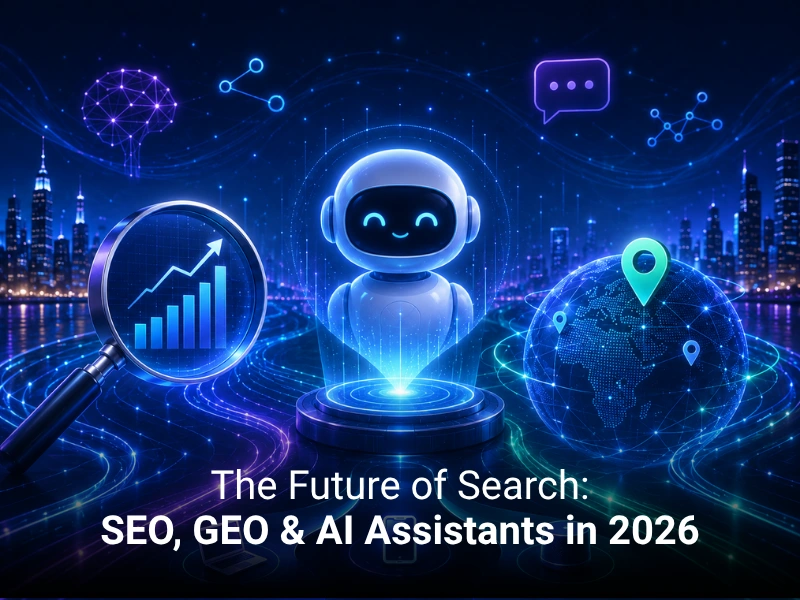
The Future of Search: SEO, GEO and AI Assistants in 2026
What Has Changed in Search? The Rise of AI Assistants
Search has moved from simple keyword matching to intent-based and conversational results. Users now expect search engines and AI systems to understand questions in natural language and return accurate answers immediately. This shift is driven by the growth of AI-powered search engines like Google SGE, Bing AI search, ChatGPT Search, and Perplexity, along with a rise in zero-click search where users get answers without visiting a website.
This is a big deal. If you are not optimizing your content for AI assistants, a large share of your potential audience will never find you, even if you are ranking on page one of Google.
Research from Ahrefs shows that AI Overviews reduce click-through rates significantly, with a 34.5% drop in position 1 CTR when AI Overviews appear. BrightEdge data reveals search impressions jumped 49% year-over-year while click-through rates dropped 30%. All of these trends create a situation where visibility increases but engagement decreases as users find answers without clicking through to source websites.
This means the game has changed. Ranking is still important, but being the source that AI assistants pull from is now equally valuable.
Understanding the Three Pillars: SEO, GEO and AEO
To win in 2026, you need to understand how these three strategies work together.
Traditional SEO: Still the Foundation
SEO is your base. Without strong technical SEO, fast page speed, clean site structure, and solid on-page optimization, nothing else will work. Google's Helpful Content guidelines and spam policies still apply fully. If your content is thin, duplicated, or written purely for bots, it will not rank.
Google's E-E-A-T framework, which stands for Experience, Expertise, Authoritativeness, and Trustworthiness, is more important than ever. Google wants to surface content written by real people with genuine knowledge. This means your author bios, your citations, your original insights, and your brand credibility all feed into whether your pages rank.
GEO: Generative Engine Optimization
GEO focuses on structuring content so generative AI systems can parse, trust, and cite it. For businesses investing in SEO services, the priority in 2026 is becoming a trusted source that AI systems consistently reference. AI-generated search systems pull concise, well-structured answers from pages that clearly explain a topic. Pages with vague introductions, repetitive filler, or weak formatting are less likely to appear in Google AI Overviews, ChatGPT recommendations, Perplexity responses, or voice assistant results.
GEO is about making your content digestible for AI. That means clear headings, structured data, factual accuracy, and writing that gets to the point fast.
AEO: Answer Engine Optimization
AEO optimizes for question-based queries, rich snippets, and voice interactions, increasing direct visibility. Think about how people talk to AI assistants. They ask full questions like "What is the best web design agency for small businesses?" not just "web design agency." AEO means structuring your content to answer these conversational queries directly and concisely.
The rise of voice-enabled conversational AI assistants means SEO is now equally about Answer Engine Optimization. Your goal is not just to get a click but to be the single, concise answer read aloud by AI systems. This requires structuring your content around natural, spoken questions.
Why Topical Authority Matters More Than Ever
One isolated blog post will not move the needle in 2026. Google and AI assistants both favor websites that cover a topic comprehensively and consistently. This is called topical authority.
If your website covers web design, digital marketing, SEO, and AI-powered search from multiple angles, Google begins to treat your domain as a reliable resource on those subjects. Over time, this builds your domain authority and makes it easier for new content to rank faster.
Topical authority and entity-based optimization matter more than isolated keyword targeting. Search visibility increasingly depends on structured content, trusted sources, and clear factual information. Businesses should track AI citations, branded visibility, and conversions instead of relying only on organic traffic numbers.
For Best Web Design, this means publishing consistent, in-depth content that covers every angle of web design, SEO, and digital visibility. Each piece you publish adds to your site's authority in the eyes of both Google and AI systems.
How AI Assistants Decide What to Recommend
Understanding how AI assistants select sources helps you optimize for them directly.
- Factual accuracy and citations: AI systems favor content that makes clear, verifiable claims. Back up your points with data, statistics, and expert references.
- Clear structure: AI assistants parse headings, subheadings, bullet points, and FAQ sections. A messy wall of text is easy for humans to skim but hard for AI to extract answers from.
- Brand mentions and entity recognition: The more your brand name appears across the web in a positive context, reviews, directory listings, backlinks, the more AI systems recognize you as a real, trustworthy business.
- E-E-A-T signals: Who wrote the content? What experience do they have? Are there author pages, bios, and credentials? These signals matter for both Google and AI-powered search.
- Fast, mobile-friendly websites: Technical SEO audits should fix critical issues like site speed, JavaScript rendering errors, and mobile-friendliness that stop sites from ranking.
Keyword Strategy for AI-First SEO in 2026
Traditional keyword research is still useful, but it needs an upgrade. In 2026, you need to think in questions, not just phrases.
Long tail keywords for AEO are highly specific, conversational phrases that target precise user intent, making them easier for AI assistants to match with direct answers. Focus on one primary long tail keyword and 2 to 3 secondary related phrases per post to maintain topical depth without keyword stuffing.
For example, instead of targeting only "web design," you should also target phrases like:
- "What makes a website rank on Google in 2026?"
- "How do AI assistants find websites to recommend?"
- "Best web design practices for AI search optimization"
In 2026, AI search assistants such as Google AI Overviews, ChatGPT, Perplexity, and Gemini have caused a spike in long-tail searches. People ask longer, more conversational questions, which makes a long tail SEO strategy more important today.
Use tools like Google Search Console, People Also Ask, and AnswerThePublic to find the exact questions your audience is typing and speaking into AI assistants.
How to Write Content That Ranks AND Gets Cited by AI
Here is a practical framework that covers both Google SEO and AI visibility at the same time.
Answer the question in the first 100 words. Content should answer the primary query within the first few lines instead of delaying the answer behind long introductions. Search systems increasingly prioritize pages that provide direct context early because AI interfaces are designed to summarize information quickly.
Use clear H2 and H3 headings. Each section should address a specific subtopic or question. This makes it easy for AI to pull a relevant section when someone asks a related question.
Include data and statistics. Numbers make your content more citable. AI assistants are more likely to reference a source that says "AI Overviews reduce CTR by 34.5%" than one that says "AI Overviews reduce clicks a lot."
Write in plain language. Conversational writing performs better in voice search and AI assistant responses. Avoid jargon where possible.
Add schema markup. FAQ schema, How-To schema, and Article schema all help AI systems understand what your page is about and extract structured answers from it.
Building Domain Authority Through AI-First Content
Domain authority is not just a number. It reflects how much the web trusts your website. To increase it in 2026, you need a combination of strong content and off-page signals.
On-page: Publish long-form, well-researched content regularly. Interlink your articles so Google and AI crawlers can navigate your site's topic clusters easily.
Off-page: Earn backlinks from reputable websites in your industry. Guest posts, digital PR, being quoted as an expert, and having your brand mentioned in industry roundups all contribute to domain authority.
Local signals: Keep your Google Business Profile complete and updated. Collect genuine customer reviews. Use location-based keywords naturally in your content.
AI citation: Every time an AI assistant cites your website as a source, it signals to the wider AI ecosystem that your content is reliable. This compounds over time and becomes a major competitive advantage.
The Search Landscape in 2026: What to Expect Next
SEO drives visibility, AEO supports answer delivery, and GEO increases the chance of being used in generative responses across AI-powered search engines. These three are no longer optional extras. They are the core of any serious digital marketing strategy.
Brands that continue to ignore AI assistants and generative search will lose ground quickly. The businesses investing now in topical authority, structured content, and GEO-optimized pages will own the AI search landscape for years to come.
AI assistants are reshaping SEO in 2026, transforming how content is created, optimized, and ranked. To stay competitive, businesses must combine AI-driven insights with human creativity, focus on user intent, and continuously adapt to evolving search patterns.
Ready to Rank in the Age of AI?
The search landscape has shifted permanently. If your website is not optimized for AI assistants, GEO, and AEO alongside traditional SEO, you are handing visibility to your competitors every single day.
Best Web Design specializes in building high-performance websites and content strategies that rank on Google and get cited by AI assistants like ChatGPT, Gemini, and Perplexity.
Book a free strategy call with Best Web Design today and find out exactly what your website needs to dominate search in 2026 and beyond.